
Introduction: Visa-Free Does Not Mean Paper-Free
Visa-free Europe sounds simple.
>No embassy forms.
>No interview stress.
>No long waiting periods.
Many travelers relax too early.
That is where problems begin.
Visa-free entry still depends on documents.
Border officers do not rely on promises.
They rely on proof.
Every year, travelers are denied entry into visa-free European countries for one reason:
missing or weak documentation.
This guide explains, in clear terms, the documents required to enter visa-free European countries, why each one matters, and how border officers interpret them.
You will learn:
- Mandatory documents travelers overlook
- Optional documents that save trips
- Country-specific expectations
- How to prepare documents for mobile and physical checks
This article is practical, calm, and written for real travel situations.
No fear tactics.
Just clarity.
What “Visa-Free Europe” Actually Means
Visa-free Europe refers to European or trans-European countries that allow short-term entry without applying for a visa in advance.
Most are non-Schengen countries.
According to Wikipedia’s visa requirements for Nigerian citizens, entry conditions still apply and are enforced strictly.
Documents decide outcomes.
Why Border Documents Matter More Than Ever
Border officers are trained risk assessors.
They ask one question:
“Is this traveler likely to overstay, work illegally, or disappear?”
Documents answer that question.
What documents communicate
- Your travel intent
- Your financial stability
- Your exit plan
- Your credibility
Missing documents increase perceived risk.
Strong documents reduce scrutiny.
The Core Documents Required Everywhere
Every visa-free European country expects a baseline set of documents.
These documents apply regardless of nationality.
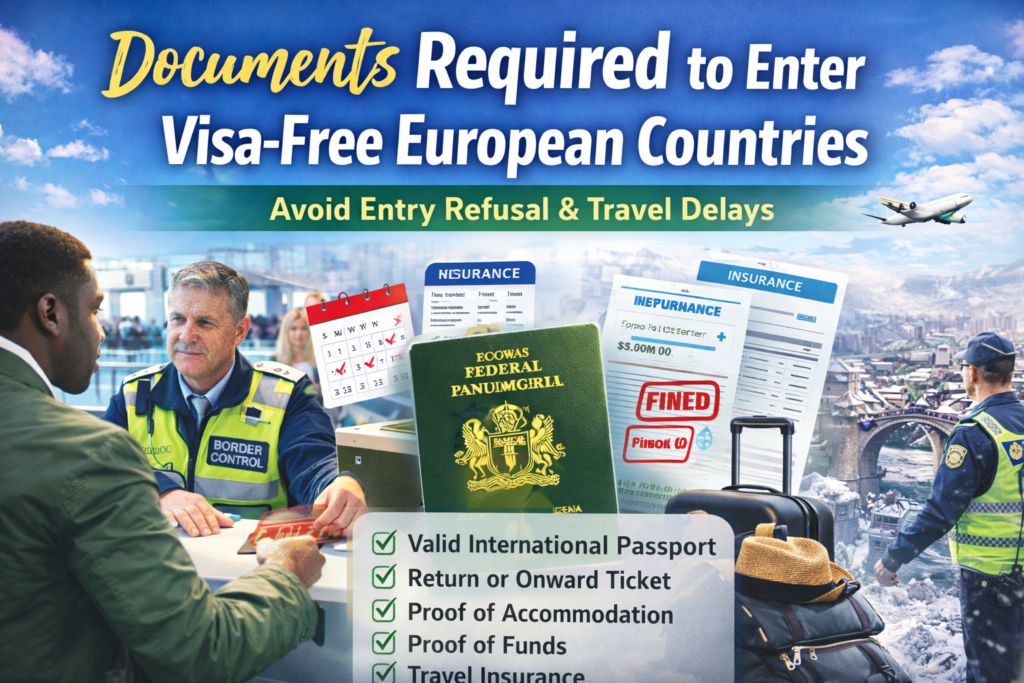
1. Valid International Passport
Your passport is your identity.
Passport requirements usually include:
- At least 6 months validity
- At least 1–2 blank pages
- No serious damage
A near-expiry passport is a common refusal reason.
Always check before booking flights.
2. Proof of Return or Onward Travel
This proves you plan to leave.
Acceptable proof includes:
- Return flight ticket
- Onward ticket to another country
- Refundable booking confirmation
One-way tickets raise suspicion.
They suggest uncertainty.
Border officers prefer clear exit plans.
3. Proof of Accommodation
This shows where you will stay.
Accepted forms include:
- Hotel reservation
- Airbnb booking
- Host invitation letter
Accommodation must cover most or all of your stay.
Verbal explanations rarely work.
4. Proof of Sufficient Funds
You must prove self-sufficiency.
Accepted proof includes:
- Recent bank statements
- Cash (local or convertible currency)
- Debit or credit cards
- Sponsorship letter with proof
No universal amount exists.
Officers judge based on stay length and destination cost.
5. Travel Insurance (Often Overlooked)
Many travelers skip this.
That is risky.
Travel insurance proves:
- Medical preparedness
- Financial responsibility
- Reduced burden on the state
Some countries ask explicitly.
Others expect it silently.
Having insurance improves credibility.
Supporting Documents That Strengthen Your Case
These documents are not always mandatory.
They often make the difference.
Recommended supporting documents
- Employment letter
- Leave approval letter
- Business registration documents
- Student ID or enrollment proof
- Invitation letter from a resident
These documents show ties to home country.
Strong ties reduce overstay risk.
Documents You Should Avoid Carrying
Some documents work against you.
Items that raise red flags
- CVs or resumes
- Job applications
- Work tools
- Multiple recommendation letters
These suggest intent to work.
Visa-free entry does not permit employment.
Country-Specific Document Expectations
Each visa-free country applies rules differently.
Understanding differences matters.
Albania
Albania allows up to 90 days visa-free for many travelers.
Border officers expect:
- Passport validity
- Hotel booking
- Proof of funds
- Return ticket
Albania is friendly but structured.
Serbia
Serbia allows 30 days visa-free for many nationalities.
Extra attention is given to:
- Accommodation details
- Clear tourism purpose
Police registration may be required after arrival.
Hotels usually handle this.
Montenegro
Montenegro allows 30 days visa-free.
Expect checks for:
- Travel insurance
- Accommodation
- Proof of exit
Tourism intent must be clear.
Bosnia
Bosnia allows 30 days visa-free.
Officers often ask:
- Where will you stay?
- How long?
- Who is hosting you?
Local registration rules apply.
Georgia
Georgia is unique.
It allows up to 365 days visa-free for many travelers.
Despite this freedom, officers still expect:
- Proof of funds
- Clear purpose
- Return or onward plan
Long stay does not mean work permission.
Armenia
Armenia allows up to 90 days visa-free.
Expect requests for:
- Hotel booking
- Insurance
- Proof of funds
Armenia values order and documentation.
Comparison Table: Mandatory vs Supporting Documents
| Document Type | Mandatory | Strongly Recommended |
|---|---|---|
| Valid passport | Yes | — |
| Return ticket | Yes | — |
| Accommodation proof | Yes | — |
| Proof of funds | Yes | — |
| Travel insurance | Sometimes | Yes |
| Employment letter | No | Yes |
| Invitation letter | No | Yes |
| Local registration proof | Country-specific | Yes |
Preparation determines confidence.
Digital vs Physical Documents: What Works Best?
Modern borders accept digital proof.
But physical backups matter.
Best practice
- Keep documents on phone
- Save offline copies
- Carry printed versions
Battery failure causes panic.
Printed backups save trips.
Mobile Optimization: How to Prepare Documents on Your Phone
Document checklist
- PDF copies of bookings
- Offline access enabled
- Screenshots as backup
- Cloud storage access
Border officers allow phone checks.
Slow phones create suspicion.
Common Document Mistakes Travelers Make
Many refusals come from simple errors.
Frequent mistakes
- Expired passport
- No return ticket
- Weak accommodation proof
- Insufficient funds
- Missing insurance
None of these are complicated.
They are overlooked.
How Border Officers Evaluate Your Documents
Officers do not just check presence.
They evaluate consistency.
What consistency means
- Dates match
- Locations align
- Answers match documents
One contradiction raises doubt.
Doubt leads to refusal.
Seasonal Impact on Document Scrutiny
Peak seasons increase checks.
During summer and holidays:
- Officers ask more questions
- Proof expectations rise
According to IATA Travel Centre, entry enforcement intensifies during high-risk travel periods.
Traveling off-peak reduces pressure.
Emotional Cost of Missing Documents
Document failure is not just technical.
It causes:
- Financial loss
- Emotional stress
- Public embarrassment
- Long-term travel damage
Many travelers never forget airport refusals.
Preparation protects dignity.
How to Build a “Visa-Free Travel Folder”
Smart travelers organize everything.
Ideal travel folder includes
- Passport copy
- Return ticket
- Accommodation proof
- Bank statement
- Insurance certificate
- Supporting letters
Keep it simple.
Keep it accessible.
Are Requirements Changing in 2026?
Yes. Slowly.
Security concerns evolve.
Migration pressure increases.
Expect:
- Stricter questioning
- Higher proof expectations
- Better digital verification
Documentation will matter more, not less.
Should First-Time Travelers Be Extra Careful?
Absolutely.
First-time travelers face:
- More questioning
- Higher scrutiny
- Less tolerance
Strong documents level the field.
What Happens If You Lack a Required Document?
Possible outcomes include:
- Secondary questioning
- Delayed entry
- Entry refusal
- Return flight at own cost
Airlines are not responsible.
Travelers bear the loss.
How to Recover From a Document-Related Refusal
Recovery is difficult.
Refusals are recorded.
Future borders may ask:
“Have you been refused entry before?”
Honesty is mandatory.
Prevention is better than repair.
Final Checklist Before Flying
Before heading to the airport, confirm:
- Passport validity
- Printed return ticket
- Hotel confirmation
- Bank proof
- Insurance certificate
Five checks prevent five problems.
Conclusion: Documents Are Your Real Visa
Visa-free Europe offers opportunity.
But documents decide access.
Your passport opens the door.
Your documents determine whether you walk through.
Prepared travelers move freely.
Unprepared travelers face resistance.
If you remember one thing, remember this:
Visa-free does not mean document-free.
Prepare wisely.
Travel confidently.
Protect your passport history.