
Introduction: Europe Is Bigger Than Schengen
For many travelers, “Europe” feels locked behind the Schengen gate.
Appointments are scarce.
Requirements feel endless.
Rejection stories spread faster than approvals.
Here is the truth most people miss: Europe is bigger than Schengen.
In 2026, thousands of travelers visit Europe every month without a Schengen visa.
>They do it legally.
>They do it calmly.
>They do it with preparation, not luck.
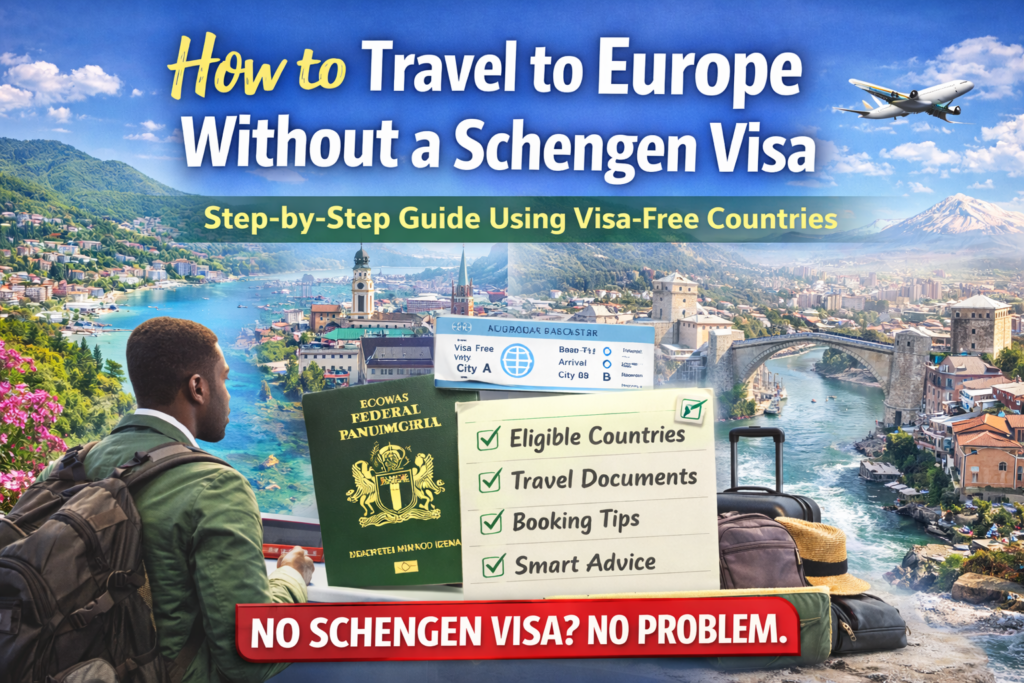
This guide shows you how to travel to Europe without a Schengen visa, step by step.
It explains where to go, what to prepare, and how to avoid the mistakes that block entry.
You will learn:
- Which European countries do not require Schengen
- The exact documents border officers expect
- How to plan routes, timing, and budgets
- What to say—and never say—at immigration
This is not theory.
It is a practical travel playbook.
Step 1: Understand What “Without Schengen” Really Means
Schengen is a group of countries, not all of Europe.
Many European and trans-European states sit outside it.
Traveling without Schengen means:
- You do not apply for a Schengen visa
- You enter non-Schengen European countries
- You follow each country’s stay rules
You still face border checks.
>You still need documents.
You simply avoid the Schengen system.
According to Wikipedia’s visa requirements for Nigerian citizens, several European destinations allow visa-free or simplified entry for non-Schengen travel.
That is your opening.
Step 2: Choose Visa-Free European Countries That Fit Your Goal
Not all visa-free countries offer the same experience.
Choose based on time, budget, and travel style.
How to decide
- Short city break: Serbia, Bosnia
- Beach and nature: Albania, Montenegro
- Long stay: Georgia
- Quiet cultural travel: Armenia
Clarity here prevents disappointment later.
Step 3: Know the Stay Limits Before Booking Anything
Visa-free does not mean unlimited stay.
Each country sets a clear limit.
| Country | Visa-Free Stay |
|---|---|
| Albania | Up to 90 days |
| Serbia | Up to 30 days |
| Montenegro | Up to 30 days |
| Bosnia and Herzegovina | Up to 30 days |
| Georgia | Up to 365 days |
| Armenia | Up to 90 days |
Overstaying damages your travel record.
Some bans extend beyond one country.
Always plan your exit date first.
Step 4: Prepare the Core Documents Border Officers Expect
This step determines success or refusal.
Visa-free entry still requires strong documentation.
Mandatory documents
- Valid passport (6+ months validity)
- Return or onward ticket
- Proof of accommodation
- Proof of funds
Strongly recommended
- Travel insurance
- Employment or business letter
- Invitation letter, if visiting someone
Documents answer one question:
“Will this traveler leave on time?”
Step 5: Book Flights Strategically (This Matters More Than You Think)
Your flight choice affects border perception.
Smart booking tips
- Avoid one-way tickets
- Use refundable return tickets if possible
- Choose direct or simple routes
Complex routes raise questions.
Clear routes feel safer to officers.
Timing matters too.
Spring and autumn reduce scrutiny.
Step 6: Plan Accommodation That Looks Credible
Accommodation is not just a place to sleep.
It is proof of intent.
Best options
- Hotels with confirmation numbers
- Airbnb bookings with host details
- Invitation letters with address
Avoid vague bookings.
Avoid canceled reservations.
Border officers verify.
Step 7: Prepare Proof of Funds the Right Way
You must show you can support yourself.
Accepted proof
- Recent bank statements
- Debit or credit cards
- Cash for short stays
There is no fixed amount.
Officers judge based on:
- Stay length
- Destination cost
- Travel style
Consistency matters more than balance size.
Step 8: Pack Like a Tourist, Not a Job Seeker
What you carry sends signals.
Avoid carrying
- CVs or resumes
- Job application letters
- Work equipment
These suggest illegal work intent.
Visa-free travel allows tourism, not employment.
Step 9: Master the Border Interview (Yes, There Is One)
Most refusals happen here.
Common questions
- Why are you visiting?
- How long will you stay?
- Where will you stay?
- When will you leave?
Best answers are:
- Clear
- Short
- Consistent
Never mention work.
Never overshare.
Calm confidence works.
Step 10: Understand Country-Specific Entry Behavior
Each country behaves differently.
Albania
Friendly but structured.
Documents are checked calmly.
Montenegro
Direct questioning.
Clear intent matters.
Serbia
Tourism-focused.
Insurance helps.
Georgia
Hospitality culture.
Accommodation proof is key.
Barnia
Long stay allowed.
Work still restricted.
Never assume uniform treatment.
Step 11: Register Locally If Required
Some countries require address registration.
Hotels often handle this.
Private stays may not.
Failure leads to fines.
Always ask your host or hotel.
Step 12: Move Between Non-Schengen Countries Carefully
You cannot hop into Schengen accidentally.
Important rule
- Visa-free Europe ≠ Schengen Europe
Crossing into Schengen without a visa leads to detention.
Check borders before traveling by land.
Step 13: Budget Realistically (Visa-Free ≠ Free)
Visa-free saves time, not money.
Typical daily costs
- Balkans: Low to medium
- Caucasus: Low
- Peak season: Higher everywhere
Budget stress causes mistakes.
Plan conservatively.
Step 14: Best Time to Travel Without Schengen
Timing changes everything.
Best seasons
- Spring (April–June)
- Autumn (September–October)
Avoid peak summer crowds.
Border scrutiny rises during holidays.
Step 15: Common Mistakes That Ruin Visa-Free Trips
Avoid these errors:
- Overstaying
- No return ticket
- Weak accommodation proof
- Mentioning work
- Relying on social media advice
According to IATA Travel Centre, entry rules are enforced in real time and change often.
Verification beats assumption.
Step 16: Can You Work or Study Visa-Free?
Short answer: No.
Visa-free entry allows:
- Tourism
- Business meetings
- Family visits
Work and study require permits.
Do not confuse access with permission.
Step 17: Sample Step-by-Step Travel Plan
Here is a simple example.
- Choose Albania
- Confirm 90-day stay rule
- Book return flight
- Reserve hotel for full stay
- Prepare bank proof
- Buy travel insurance
- Fly in spring
- Answer questions calmly
- Exit before deadline
Simple plans succeed.
Comparison Table: Schengen vs Non-Schengen Europe
| Factor | Schengen | Non-Schengen Europe |
|---|---|---|
| Visa required | Yes | Often No |
| Embassy visit | Mandatory | Not needed |
| Entry stress | High | Moderate |
| Flexibility | Low | Higher |
| Cost | Higher | Lower |
Non-Schengen travel favors speed and flexibility.
Emotional Reality: Why This Route Works
Travel without Schengen reduces anxiety.
You avoid:
- Embassy pressure
- Rejection fear
- Long waits
You gain:
- Confidence
- Experience
- Travel history
Many travelers later apply for Schengen stronger.
Final Checklist Before You Fly
Confirm these five items:
- Passport validity
- Return ticket
- Accommodation proof
- Funds proof
- Insurance
Five checks save thousands.
Conclusion: Europe Is Still Open—If You Know the Route
You do not need a Schengen visa to experience Europe.
You need strategy.
Visa-free Europe rewards travelers who:
- Prepare documents
- Respect rules
- Travel with clarity
Now you know how to travel to Europe without a Schengen visa, step by step.
Use this knowledge wisely.