

Introduction: The European Travel Confusion That Costs Travelers Time, Money, and Opportunities
Many travelers believe Europe works as one unified travel zone. They assume a single visa grants access everywhere. Unfortunately, this misunderstanding causes missed flights, visa refusals, overstays, and unexpected border issues.
Europe is divided into different travel frameworks. The most important distinction is between Schengen and non-Schengen countries.
Understanding this difference is essential because it affects:
- Visa requirements
- Border controls
- Length of stay rules
- Travel planning strategy
- Budget and logistics
If you plan to visit multiple European countries, misunderstanding these systems can create serious complications.
This guide explains everything clearly and practically. You will learn how the systems work, why they exist, and how smart travelers use this knowledge to build seamless European itineraries.
What Is the Schengen Area? A Simple Explanation
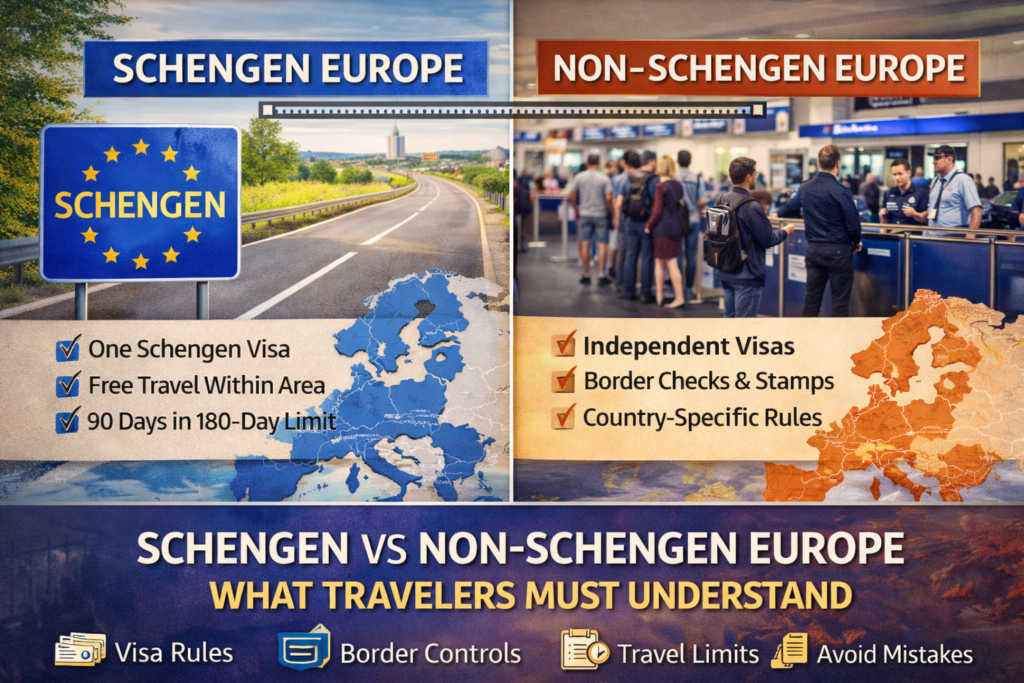
The Schengen Area is a group of European countries that removed internal border controls between themselves.
Once you enter one Schengen country legally, you can move freely between others without passport checks in most cases.
The system exists to promote easier movement across Europe.
Key Characteristics:
- No routine internal border checks.
- Shared visa policy.
- Unified short-stay visa rules.
Examples of Schengen countries include:
- France
- Germany
- Italy
- Spain
- Netherlands
- Switzerland
- Austria
- Greece
According to official Schengen policy guidelines, the agreement allows travelers to move across participating countries as if traveling domestically.
What Is Non-Schengen Europe?
Non-Schengen Europe includes countries located in Europe but operating outside the Schengen border-free system.
These countries maintain independent border controls and visa rules.
Examples include:
- United Kingdom
- Ireland
- Romania
- Bulgaria
- Cyprus
- Serbia
- Albania
Traveling between Schengen and non-Schengen countries often involves passport checks.
Some require separate visas even if you hold a Schengen visa.
Why Europe Has Two Different Systems
The division exists due to political agreements, security policies, and national immigration decisions.
Not all European countries chose to join Schengen.
Reasons include:
- Border control preferences
- Security policies
- Legal frameworks
- Economic considerations
This creates a unique travel landscape where geography and immigration rules do not always align.
Schengen vs Non-Schengen: Quick Comparison Table
| Feature | Schengen Countries | Non-Schengen Countries |
|---|---|---|
| Internal borders | Mostly open | Border checks required |
| Visa system | Unified Schengen visa | Independent visas |
| Length of stay rules | 90/180 rule | Country-specific |
| Travel flexibility | High | Moderate |
| Border control frequency | Minimal internally | Regular checks |
Understanding these differences helps you avoid unexpected visa issues.
The 90/180 Rule Explained Clearly
One of the most misunderstood Schengen regulations is the 90/180 rule.
It means:
- You can stay up to 90 days within any 180-day period across all Schengen countries combined.
Example:
- 30 days in France
- 30 days in Italy
- 30 days in Spain
This equals 90 days total.
You cannot restart the clock by moving between Schengen countries.
Why Travelers Confuse EU and Schengen
Many assume European Union membership equals Schengen membership.
This is incorrect.
Examples:
- Ireland is in the EU but not in Schengen.
- Switzerland is not in the EU but is in Schengen.
Always verify visa requirements based on Schengen membership, not EU status.
Border Crossing Differences: What Travelers Experience
Within Schengen:
- Train journeys often have no passport checks.
- Flights feel like domestic travel.
Between Schengen and non-Schengen:
- Passport control occurs.
- Entry stamps may be added.
Expect different procedures even within Europe.
Visa Planning Strategy: Schengen vs Non-Schengen
Smart travelers design itineraries around visa rules.
Schengen Planning:
- Choose main destination country carefully.
- Apply through embassy where you stay longest.
Non-Schengen Planning:
- Check separate visa requirements.
- Verify entry conditions individually.
Planning prevents costly travel interruptions.
Popular Non-Schengen Destinations Travelers Forget About
Many attractive European destinations are non-Schengen.
Examples:
- United Kingdom (London, Scotland)
- Serbia (Belgrade nightlife)
- Albania (Mediterranean beaches)
- Montenegro (budget-friendly coastline)
These countries can extend travel time beyond Schengen limits.
Using Non-Schengen Countries to Extend Your European Trip
Smart travelers leverage non-Schengen destinations.
Example:
- Spend 90 days in Schengen.
- Move to non-Schengen country.
- Allow Schengen time to reset.
This strategy requires careful tracking of days.
Travel Budget Differences Between Zones
Costs vary significantly.
Schengen:
- Often higher prices.
- More tourism infrastructure.
Non-Schengen:
- Frequently cheaper destinations.
- Less crowded experiences.
Budget-conscious travelers often combine both.
Transportation Differences Between Regions
Schengen travel feels seamless.
You may not notice crossing borders.
Non-Schengen travel may involve:
- Passport checks.
- Immigration queues.
- Additional documentation.
Travel Insurance Requirements
Schengen visa holders must carry insurance meeting minimum coverage requirements.
Non-Schengen countries may have separate rules.
Always check requirements individually.
Common Mistakes Travelers Make
Avoid these:
- Assuming Schengen visa covers UK entry.
- Miscalculating 90-day limit.
- Overstaying unknowingly.
- Confusing EU and Schengen membership.
These mistakes cause entry bans.
Visual Comparison Guide
How Immigration Officers Track Your Travel
Entry and exit stamps help authorities calculate your stay duration.
Digital systems increasingly monitor movements.
Overstays are detected easily.
Planning Multi-Country Trips Without Visa Problems
Tips:
- Track days carefully.
- Keep travel records.
- Plan entry and exit points.
Use calendar tools to avoid overstaying.
Technology Tools for Tracking Schengen Days
Helpful tools include:
- Schengen calculators.
- Travel planning apps.
- Budget tracking platforms.
According to Schengen travel information resources, tracking your stay duration is essential to maintain compliance.
Luxury vs Budget Travelers: Different Planning Strategies
Luxury travelers:
- Often fly between countries.
- Use concierge visa assistance.
Budget travelers:
- Travel by train or bus.
- Stay longer in fewer locations.
Both must respect visa limits.
Future Changes: ETIAS and New Entry Rules
Europe plans to introduce ETIAS for visa-exempt travelers.
This electronic authorization system adds pre-screening before arrival.
Stay updated before planning travel.
Psychological Stress vs Smart Planning
Many travelers worry unnecessarily because rules feel complex.
However:
- Once you understand zones, planning becomes easy.
- Clear knowledge reduces travel anxiety.
How to Build the Perfect Europe Itinerary Using Both Zones
Example:
- 60 days Schengen (France, Italy).
- 30 days UK.
- 30 days Albania.
This extends travel while respecting visa rules.
Conclusion: Understanding Schengen vs Non-Schengen Unlocks Smarter European Travel
Europe offers incredible travel diversity, but immigration frameworks require careful understanding.
Schengen countries provide seamless border-free movement.
Non-Schengen destinations offer flexibility and opportunities to extend travel legally.
The smartest travelers combine both strategically.
When you understand:
- Visa systems
- Border rules
- Stay limits
You gain control over your journey and avoid costly mistakes.
Knowledge transforms Europe from a confusing system into an exciting and manageable adventure.
Frequently Asked Questions (FAQs)
1. Is the UK part of Schengen?
No. The UK operates its own independent visa system.
2. Can I visit multiple Schengen countries with one visa?
Yes, within the 90/180 day rule.
3. Does leaving one Schengen country reset my stay time?
No. All Schengen countries count as one zone.
4. Are all EU countries in Schengen?
No. Some EU members remain outside the Schengen system.
5. Can visiting non-Schengen countries extend my Europe trip legally?
Yes, if you respect Schengen time limits.


